
The topic of hydration always makes me laugh a bit because, as a Gen-Xer, I must have spent my childhood seriously dehydrated! The notion to bring a “water bottle” to school did not exist. Water bottles did not exist! I went to elementary school in Las Vegas and Ft. Worth, TX (where my dad was stationed in the Air Force). Both of these are seriously hot places! And all we had was a drinking fountain that we all stood in line for to gulp down as much as we could before the teacher counted to 5.

Honestly, I don’t think my kids know how to use one of these.
If you’re my age, you know we all grew up playing outside ALL DAY LONG, and what did we do when we got thirsty?

Somehow, we survived our childhoods, and now we know better!
1. A Few Facts about Hydration
Mechanics of Thirst:
You’ve probably heard the saying, “If you’re feeling thirsty, you’re already dehydrated.” Well, friends, it’s absolutely true. And by now, you know how I roll . . . I love the nerdy mechanics of this stuff . . .
Here’s how our Thirst Mechanism works: The amount we drink (or don’t drink) affects our blood volume (the amount of fluid flowing through our circulatory system). Lower fluid intake leads to lower blood volume. Because our bodies are always seeking homeostasis, or balance, our circulatory system is equipped with baroreceptors that sense slight variations in blood pressure driven by our blood volume. These baroreceptors trigger the hypothalamus in our brains. The hypothalamus has many functions and I like to think of one of its critical roles as the “Homeostasis Hall Monitor.” It oversees and regulates our fluid balance (aka – hydration), body temperature (and a few other things). I wrote about the hypothalamus and its role as our bodies’ thermostat (here) and (here). When the hypothalamus receives the “low fluid volume” warning from our baroreceptors, it triggers a couple of areas in our brain that, in turn, create the signal to make us feel thirsty.
It is important to note that as we age, this thirst mechanism works less efficiently, causing older adults to have a diminished sense of thirst. Studies show that by the age of 65, that diminished sense of thirst significantly increases the risk for severe dehydration.
Consequences of Dehydration:
Even very slight dehydration can cause:
- fatigue
- irritability
- poor sleep
- headaches
- muscle cramps
- constipation
Dehydration and Menopause:
The hormonal shifts of menopause can make us more prone to dehydration. Combine that with the decreased efficiency of our natural thirst-indicating mechanism, and we can quite easily find ourselves in serious trouble.
Staying hydrated in menopause can help with:
- Preventing UTIs – dehydration results in highly concentrated urine, which irritates our bladder and urinary tract and increases our risk of UTIs. Conversely, when we are well-hydrated with healthy (pale yellow) urine, we can flush bacteria out of our urinary tract.
- Dehydration stresses the hypothalamus, and its ability to efficiently function as our bodies’ thermostat, which makes us more prone to hot flashes.
- Dehydration can increase the severity of menopausal brain fog.
Winter and Dehydration:
Colder temperatures in winter cause our thirst response to diminish. At the same time, our bodies are expending a significant amount of energy to retain heat, which results in fluid loss. The heaters in our homes dry out the air, which dries us out. We have a lot of strikes against us in maintaining our hydration in winter, which means we need to be strategic in managing it.
2. Start Hydrating the Moment You Wake Up
Sorry friends, this does not mean hydrating with our coffee.
Re-Hydrating our bodies should begin as soon as we wake up. Hopefully, we’ve gotten a full 8-hours of sleep, but during that time our bodies have become dehydrated, so we must replenish to get our day off to a good start.
I always put a big glass of water on my nightstand at bedtime. Typically, I drink a couple of sips if I wake up in the middle of night with a dry mouth, but there’s usually a lot of water waiting there for me when I wake up. So I drink that water before I even get out of bed.
When I go down to the kitchen in the morning, I’m usually on a mission to make my coffee. While it’s brewing, I drink another full glass of water. Tragically, the caffeine in our coffee (or tea) acts as a diuretic. Diuretics increase our urine output, which . . . you guessed it . . . dehydrates us. Rest assured, I’m not telling you to omit your morning coffee (gasp!), I’m saying we need to replenish our bodies with water before, during, and after consuming it.
3. Embrace the Ritual of Decaffeinated Herbal Teas
Because I value my sleep (and often struggle with it), I really try to limit my coffee intake in the morning to one big, lovely, delicious, strong cup. But after that, I’m left in my chilly house, wanting more warm stuff to drink.

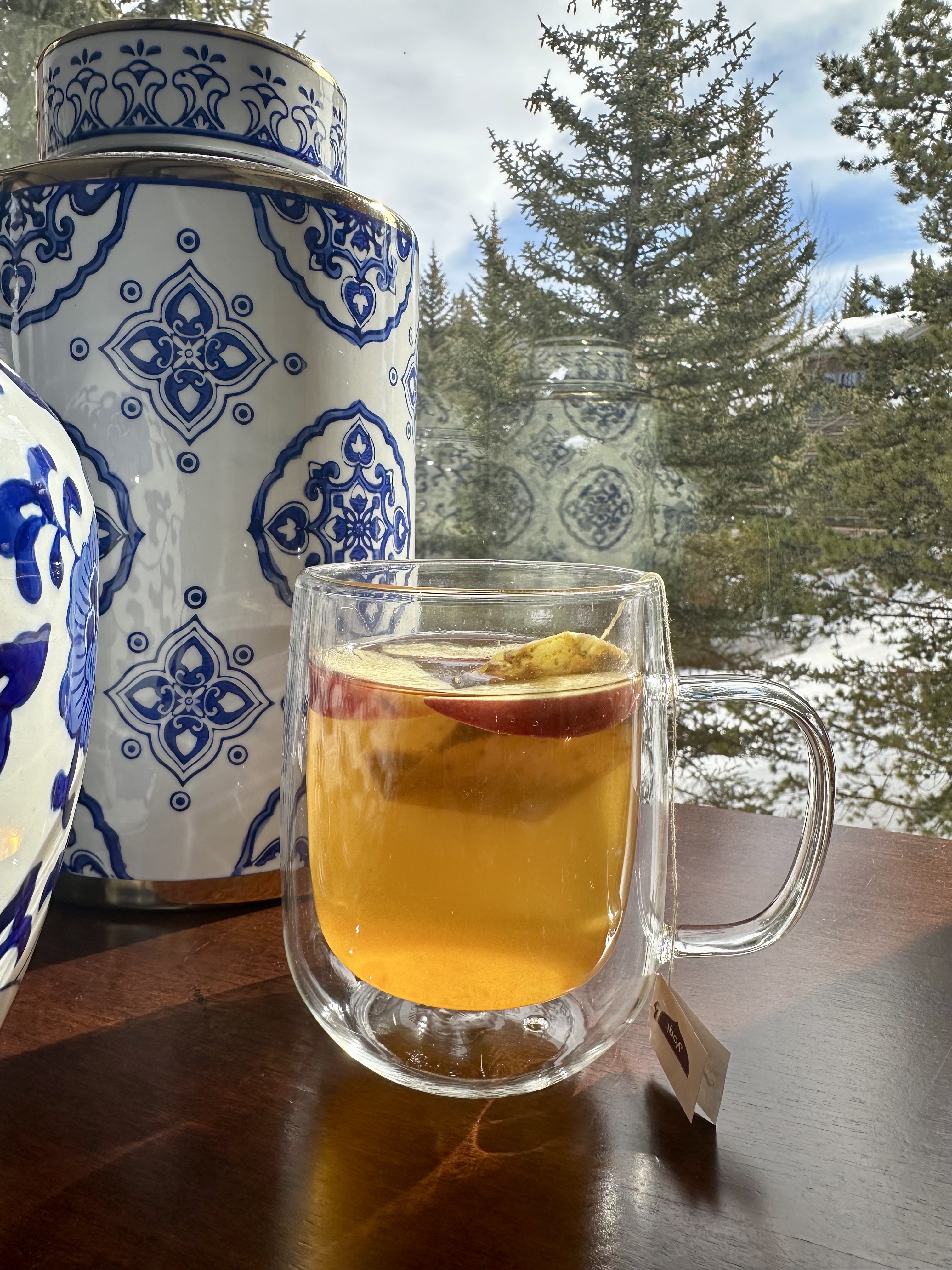
Since moving to a much colder climate, I have come to enjoy hot, decaf teas. It has become somewhat of a ritual to help me break up my day. I have several friends who are serious tea drinkers with sophisticated palettes and enjoy brewing loose tea. I’m more of an “entry-level” drinker of teas, but I’m learning a few tricks that make it a really enjoyable (and hydrating!) part of my day.
I started by buying an electric Kettle. These heat up so much faster than a stove-top kettle, and I feel much more grown up using one versus sticking my mug of water in the microwave like a cavewoman. 😂 I’ve found several flavors of herbal or fruit teas that I enjoy, and I’ve learned that I love to add a little slice of fruit to my teas. My current favorites are a slice of apple or orange.


4. Safe Electrolyte Replenishment
We’re all moving our bodies through menopause, right?! (Please say “yes”! And if that’s not your answer, read my last Five to Thrive post!). If we’re getting significantly sweaty, we need to replenish the fluids and electrolytes that we sweat out because . . . what is our body seeking? . . . Homeostasis. The key here is to safely and appropriately replenish the electrolytes that we sweat out.
Electrolytes are minerals that serve specific functions in our bodies, depending on the type. They support fluid balance, muscle function, nerve function, and heart health. Maintaining homeostasis with our electrolytes and fluids is super important, BUT I really want you to be aware that, in the case of electrolytes we CAN get too much of a good thing! I see a lot of products, health bloggers, and influencers encouraging us to hydrate ourselves throughout the day with electrolytes, and, as a nurse, I discourage that. Electrolyte imbalance (too high or too low) can be very dangerous.
Unless you’re an athlete, doing multiple workouts, or running a marathon, your body does not need to be flooded with excess electrolytes. We typically get the electrolytes we need through a balanced diet. When it comes to replacing electrolytes, we are looking for the Goldilocks method – not too little, not too much, but just right. According to New York Presbyterian Hospital (link), the rule of thumb with electrolyte replacement is if you’re working out intensely for an hour or more, or exercising in the heat, you should replenish your electrolytes AND fluids.
When shopping for electrolyte replacement products, I encourage you to:
- Look for products that are sugar-free. Many are loaded with sugar and can negatively impact your blood glucose levels.
- Look closely at Sodium (Na) levels. Many products have very high amounts of sodium that are not appropriate unless you are sweating excessively. I have been using Nuun tablets because they are lower in sodium than most, and my blood pressure tends to lean towards the higher side.
Signs and Symptoms of Electrolyte Imbalance include:
-severe muscle cramping
-confusion or irritability
-diarrhea OR constipation
-nausea/vomiting
-numbness or tingling in extremities
-irregular heart rate or palpitations
If you experience these symptoms after working out, consult your physician.
5. My Favorite Hydration Hack
Finally, one of the best things I have found for staying hydrated is my Sodastream. I am a big fan of sparkling water, and for years, I was buying canned flavored seltzers and expensive bottles of sparkling water. I was at someone’s house and they used a soda stream – NOT to add in the soda flavors – but just to make bottles of sparkling water. What?? This had never occurred to me!! I went home, ordered my Sodastream, and have been thrilled with it from day one! For some reason, pouring myself a glass of sparkling water, and adding a slice of citrus to it, feels like such a treat, and I drink SO MUCH more water throughout my day! I swear this thing paid for itself in a month.

I bought this Sodastream, but they have many models to choose from. They have a CO2 cartridge that fits neatly inside a hidden compartment. I like that I can order my cartridges from Sodastream while returning my empties to them for a discounted rate. Like I said, I don’t use (nor do I recommend) their flavors. They are full of chemicals none of us need. Depending on the day, I drink one to two liters of this water a day, and I estimate that one cartridge lasts me about six weeks.
When making carbonated water with the Sodastream you must ONLY use the bottles that come with it (for safety reasons). I like to have a few bottles in the fridge and I prefer storing my water in glass vs plastic, so I make the sparkling water, then pour it into these glass bottles that have excellent seals to retain the carbonation. (Plus they’re super cute!) Italian Glass Water Bottle with Seal. I’ve had these for 3 years, and they still keep a perfect seal.

In addition to adding a wedge or two of citrus, I have found that I can get creative with some fun sparkling water concoctions. Some of my favorites:
- Add a little splash of tart cherry juice (thought to be great for sleep!) with a slice of lime.
- Muddle (smush) a few fresh berries and add a sprig of mint, basil or rosemary. These feel like an Elevated Mocktail!
- Muddled Blackberry, mint, and a lime wedge = blackberry “Nojito”
- Muddled blueberries, basil and lemon = well, I don’t have a name. Taking suggestions.
- Strawberry with basil . . . Cranberry with rosemary . . . You get the idea!
- In the summer, Trader Joe’s has cold-pressed watermelon juice (in the refrigerated juice section). Add a splash of this with a slice of lemon or lime, and you will be HOOKED! Soooo good!
Alright, friends, that’s our Five to Thrive for this week! I hope this gives you some ideas for staying hydrated through the winter (and beyond!). If you have other ideas, PLEASE share them with us in the comments!
As always, please know that I truly appreciate you taking a little time for yourself and spending it with me. I hope you have a wonderful day, and I’ll see you back here tomorrow!
*Note about Affiliate Links: I have created some links to products that I have researched and personally use and enjoy. In utilizing these links, Elevated Nesting may earn a small commission (at no additional cost to you).





Thank you, Steph! I appreciate that so much! Have a wonderful week!