
Here I am again . . . writing about SLEEP! In my experience as a nurse in women’s health, the two most common complaints of menopausal patients were: Hot Flashes and Poor Sleep. There are so many reasons I’m passionate about this topic in terms of:
- Supporting our overall health and wellbeing
- The role that Menopause plays in affecting our Sleep
- The role that Sleep plays in affecting our Menopause symptoms
Sleep and Menopause Seem to be at Odds with Each Other
The hormonal swings of Perimenopause and the steady decline in estrogen and progesterone of Menopause have a serious impact on our ability to get a solid night of good restorative sleep. Throw in some of our “favorite” menopause symptoms like night sweats, heart palpitations, and anxiety, and we have a not-so-tasty cocktail of sleep disruptors
Let’s compound this with the fact that poor sleep has an antagonistic effect on many of our menopause symptoms: fatigue, brain fog, depression/anxiety. So menopause can make our sleep worse, and poor sleep can make our menopause symptoms worse. We MUST get a handle on this! We absolutely deserve to feel and enjoy the benefits of consistently good sleep.
If sleep continues to be elusive for you, it may be time to consider incorporating a supplement, or a synergistic combination of supplements, into your routine. Now, to be clear, I don’t want us to approach the idea of using sleep supplements to improve our sleep without also incorporating specific strategies and lifestyle habits that will work symbiotically with supplements.

- I have written about sleep strategies here.
- And I’ve written about creating an environment to support sleep here.
Safety First!
There are so many sleep aids and supplements on the market. Because we are all different, what works for your girlfriend may not work for you. It is very important to not take the approach of “throwing the whole kitchen sink” at your sleep problems. I always recommend starting with a “less is more” approach. Read up on these supplements, consult your doctor, choose an appropriate one for you. I recommend a low dose to begin with.
If you are already taking medications for sleep, always consult your doctor and use extreme caution before adding a sleep supplement into the mix.
Remember that any supplement or medication that induces sleepiness can have the potential to cause dizziness or lightheadedness, so always be cautious when you’re getting out of bed and standing up.
Just as it is not safe to take a prescription sleep medication or painkiller with alcohol, you should also avoid mixing it with a sleep supplement. (Also, friends, remember that alcohol is a known sleep disruptor, so factor that into your lifestyle choices).
We are all vastly different. What works safely for me may not be safe or effective for you.
~ You may have medical conditions or be taking certain medications that could negatively interact with these supplements.
With that fact in mind, please:
~ Always check with your healthcare provider before introducing any new supplement.
~ Always include all of your supplements on your medication list.
Common Sleep Supplements for Menopause-Induced Insomnia
Magnesium, often referred to as the “Calming Element” calms our nervous system and quiets the mind by:
- blocking stimulating neurotransmitters
- binding to the neurotransmitters in the brain that promote relaxation
- promoting the availability of GABA (a calming neurotransmitter)
- regulating the release of stress hormones – cortisol and epinephrine.
I’m a big fan of magnesium as a critical electrolyte (Yes, it’s an electrolyte!) for menopause support. In fact, I wrote a whole article about it! Magnesium Matters, and I encourage you to go back and review that information!

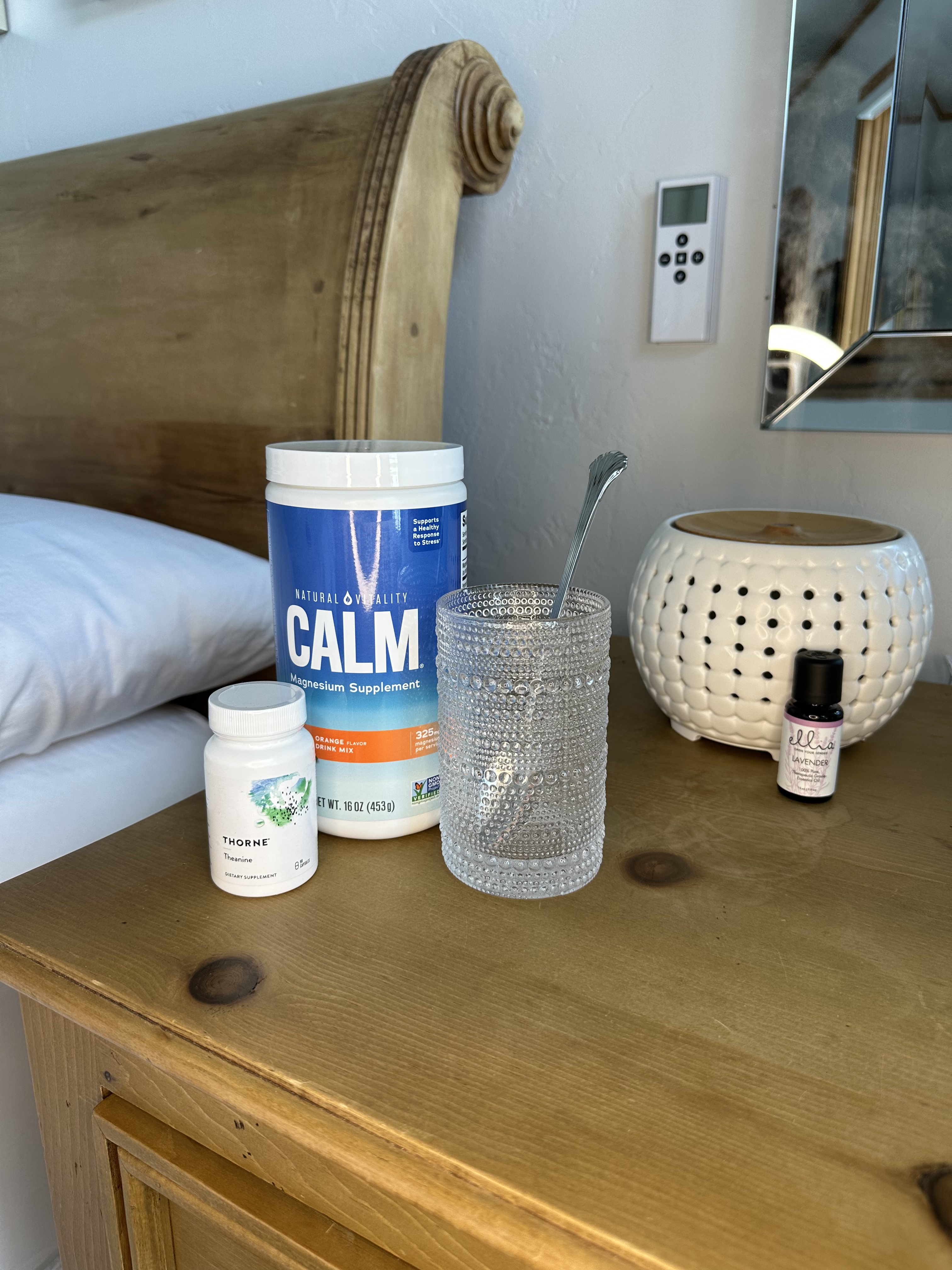
I’ve tried a few forms of magnesium, but for sleep, specifically, this (link) is the one I keep going back to because it consistently works for me. Bonus: it also keeps me regular!
I combine a nightly dose of this magnesium with:
L-Theanine. An amino acid that, for some people, enhances the production of GABA (a neurotransmitter in the brain that calms stress and induces relaxation). For me, the combination of Magnesium and L-Theanine has worked well. It may not work for everyone. But, if you’re struggling, and have not tried these, consult your doctor and give them a try.
I like this Thorne brand for L-Theanine (and many other supplements) because it is very purely sourced. Link.

I have not tried the following Sleep Supplements, but, in my nursing practice and research many women get great results from:
GABA – is an amino acid that acts as a calming neurotransmitter in the brain. As I mentioned above, magnesium and L-Theanine help to promote the bioavailability of GABA, which stands for gamma-aminobutyric acid. (Thank goodness they shortened it!) I have not personally used GABA as a stand alone sleep supplement, but it is widely used to quiet the mind and increase relaxation for better sleep. It is found naturally in several varieties of teas, as well as in fermented foods like yogurt, kefir, and tempeh. If your doctor approves, I encourage you to start with a very small dose of GABA. For some, supplementing with GABA can cause stomach cramps, nausea or diarrhea. Some blood pressure medications combined with GABA may cause blood pressure to go to low, so as always, check with your physician before starting.
(Gottesmann, 2002)
Valerian Root – Studies have shown that Valerian can have similar effects to sleep-inducing drugs in the categories of benzodiazepines and barbituates BUT without the addictive qualities or morning drowsiness. It is a common ingredient in a variety of sleep aids, and many report that in addition to helping them fall asleep, Valerian can prevent nighttime awakening.
(Northrup, 2021)
Glycine – is another amino acid that acts as a neurotransmitter. It is found in high-protein foods – meats, beans/lentils, and dairy. It is thought to boost melatonin and serotonin production. One result of Glycine that I find especially applicable to women in perimenopause and menopause is that it has been shown to lower our core body temperature. As you read in my article on creating a sleep-promoting environment (link), “the release of melatonin triggers our hypothalamus (our brain’s thermostat) to lower our core body temperature by as much as 2 degrees at night. This cooler core temperature allows our bodies to reach slow-wave sleep, which is that deep restorative sleep we’re all chasing.”
Please note that Glycine, like most other supplements, can be harmful in large quantities. Consult your doctor, and use it appropriately.
(Summer & Adavadkar, 2023)
Centuries-old Sleep Aids that you *may be able to incorporate into your Nighttime Routine

Lavender has anxiolytic (anxiety-reducing) qualities and has been used for centuries to induce calm and sleep. It can be used in a variety of modalities, and in addition to its propensity to relax us, it has anti-inflammatory and pain-relieving properties as well as anti-bacterial capabilities.
- Taken Orally as a supplement, Lavender can be used for insomnia as well as to treat physical pain and headaches.
- Used topically in cream form, Lavender can act as a muscle analgesic to ease muscle pain and stiffness.
- Lavender oil can be used in a diffuser next to your bed and, as such, has been shown to improve sleep quality. Some studies have shown that Lavender Aromatherapy can increase the amount of time spent in deep, slow-wave sleep.
* Lavender is another supplement that can lower your blood pressure, so use caution if you are taking blood pressure meds.
(Breus, 2024)
Chamomile tea is another one that has been used for centuries to help with sleep. It is thought to bind to GABA receptors in the brain, inducing a sense of calm. It’s recommended that you drink a cup of chamomile tea about 45 minutes before bedtime. This allows your body to metabolize the tea and for the sleepy effects to take place.
* Chamomile Tea is not safe for everyone:
- Chamomile should be avoided by pregnant women because of an increased risk of miscarriage.
- Chamomile is a wildflower related to ragweed, so it should be avoided by those with certain allergies or asthma.
You’ll notice I skipped a big one in the sleep supplement category – Melatonin. I have an entire article dedicated to Melatonin that I’ll publish next week! There is so much information and research on this fascinating sleep hormone, and I’m so excited to share it with you!
Thank you so much for learning with me today!
My week has been a bit crazy, so I will catch up with all of you on Monday! Have a Restful Weekend, Friends!!
*Note about Affiliate Links: I have created some links to products that I have researched and personally use and enjoy. In utilizing these links, Elevated Nesting may earn a small commission (at no additional cost to you).
Resources:
Breus, Dr. M. (2024, April 29). Does lavender help you sleep?. Sleep Doctor. https://sleepdoctor.com/sleep-aids/does-lavender-help-you-sleep#:~:text=For%20sleep:%20Lavender%20oil%20is%20a%20popular,increase%20time%20spent%20in%20deep%2C%20slow%2Dwave%20sleep.
Gottesmann, C. (2002). GABA mechanisms and sleep. Neuroscience. https://pubmed.ncbi.nlm.nih.gov/11983310/
Northrup, C. (2021). The Wisdom of Menopause: Creating Physical and Emotional Health During the Change (4th ed.).
Summer, J. V., & Adavadkar, P. (2023, July 14). Glycine for sleep. Sleep Foundation. https://www.sleepfoundation.org/sleep-aids/glycine-for-sleep




Thank you, Steph! I appreciate that so much! Have a wonderful week!